
How much extra safety does a gated apartment community really add?
By San Antonio Apartment Locators Group · Updated 2026-07-11
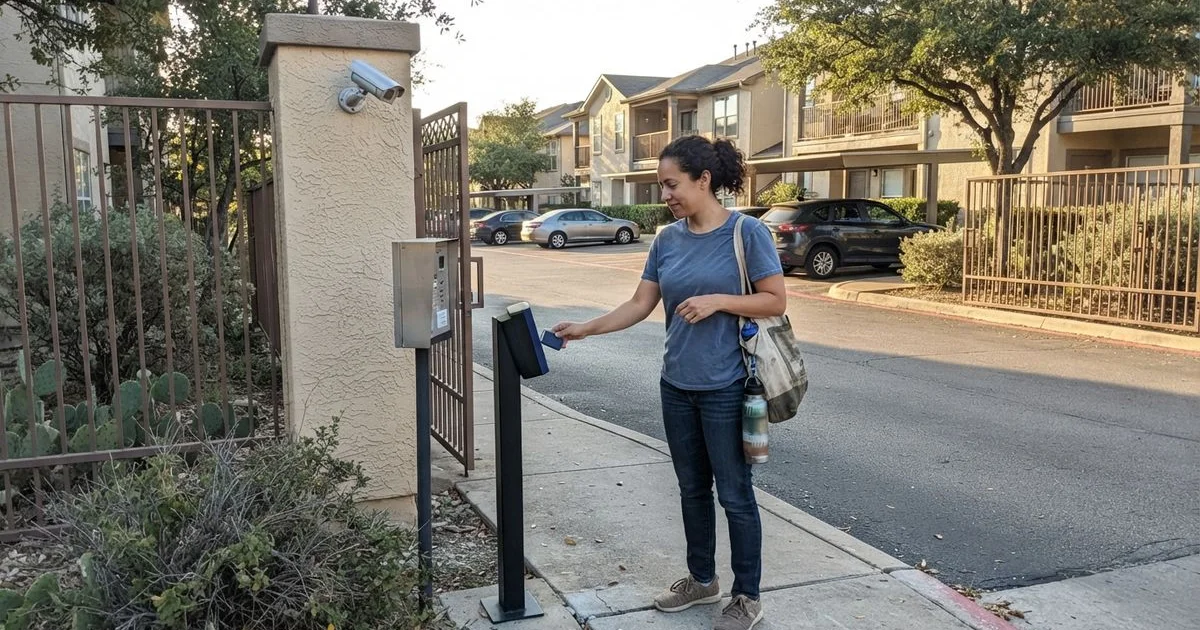
A gated entrance is one of the most visible features separating gated and secured communities from standard apartment properties in San Antonio, but “gated” can mean very different things depending on the property. Here’s what to actually evaluate.
What “gated” typically includes, and what it doesn’t
At its most basic, a gated community restricts vehicle access with a keypad or remote-controlled gate, which cuts down on casual through-traffic. Some properties add more: monitored entry, controlled pedestrian access, on-site courtesy patrol, or camera coverage across common areas. Others offer little beyond the gate itself. The label alone doesn’t tell you which version you’re looking at, so it’s worth asking specifically what’s included rather than assuming a baseline.
What actually affects how safe a community feels
Gate access is only one factor. Lighting across parking areas and walkways, how well common areas are maintained, and whether the property has any staff or courtesy patrol presence in the evening all affect how safe day-to-day living actually feels. A gated property with poor lighting and an often-broken gate may offer less real security than a well-lit, attentive standard community.
| Feature | What to ask about | Why it matters |
|---|---|---|
| Gate type | Keypad, remote, or monitored entry | Determines how easily the gate can be bypassed or left open |
| Lighting | Coverage across parking and walkways | Directly affects nighttime safety |
| Staff or patrol presence | On-site security versus cameras only | Cameras record incidents; presence can prevent them |
| Gate maintenance history | How often it’s reported broken or propped open | A frequently broken gate offers little real security |
What a gate doesn’t protect against
A controlled entrance mainly limits vehicle and pedestrian access at the main entry point, but it doesn’t prevent issues that can happen within a community regardless of whether it’s gated, like a dispute between neighbors or a package theft from a doorstep. Framing a gate as one layer of a broader safety picture, rather than a complete solution, sets more realistic expectations than treating the label itself as a guarantee. Good lighting, active management, and a community where neighbors know each other tend to matter just as much as the entry system itself. A gate also has nothing to do with what’s happening inside the unit’s walls; pest and mold problems are a separate health risk worth checking regardless of how secure the entrance is.
Questions worth asking directly on a tour
Ask how often the gate malfunctions or gets propped open, since a gate that’s broken half the time provides a false sense of security rather than a real one. Ask whether there’s any staff or courtesy patrol presence in the evening, and whether common area lighting has had any recent complaints. These specifics tell you far more than the marketing description of “gated and secured.”
Weighing the cost against what you’ll actually get
Gated communities generally carry a modest premium over standard properties. Whether that premium is worth it depends on how much weight you personally put on controlled access versus other factors like unit condition or amenities. If personal safety is a top priority, confirm the specific features in place rather than assuming the gate alone covers it. A well-run standard community with good lighting and responsive management can offer comparable peace of mind for less money.
Visiting at a different time than your scheduled tour
A daytime tour rarely shows you what a property is like at 9pm on a weeknight. If you’re seriously considering a gated community for the safety features specifically, drive by in the evening to see whether the gate is functioning, whether the lot and walkways are well lit, and how the property actually feels after dark. This single extra step reveals more than most of what a leasing agent will tell you during business hours.
Making the comparison with real data, not just a tour
Resident reviews often mention specific safety-related experiences that a single tour won’t reveal, like how quickly a broken gate gets fixed or whether lighting complaints are common. Checking our scoring methodology alongside recent feedback gives you a fuller picture before deciding whether the gated premium is worth it for your situation, since a property’s actual track record over time tends to say more about real safety than its marketing copy ever will.
FAQ
- Does a gated entrance mean an apartment community is safer?
- It reduces casual through-traffic and unauthorized vehicle access, but it doesn't eliminate risk entirely. Overall safety depends on lighting, staff presence, and maintenance of the security systems, not just the gate itself.
- What security features should I actually confirm on a tour?
- Ask whether the gate is monitored or just a keypad, how often it's reported as malfunctioning, whether common areas are well lit at night, and if there's any on-site security presence versus cameras alone.
- Is it worth paying more for a gated community?
- It depends on your priorities. If personal safety and controlled access genuinely matter more to you than other amenities, the premium can be worth it, but a well-lit, well-maintained standard community can offer comparable peace of mind.
- Do gated communities have fewer maintenance issues?
- Not necessarily. Gate and security infrastructure is one more system that can fall into disrepair if not maintained, so a broken or propped-open gate is a red flag worth asking about directly.